What happens when the border stops being a line on a map and becomes a haunting?
What happens when it appears not only at the edge of a country, but in neighborhoods, airports, libraries, schools, memories, bodies, and imaginations?
In this episode of Your Art Is a Spell, I speak with Ed Gomez—artist, educator, curator, and co-founder of the MexiCali Biennial—about Paranormal Borders, an expansive new exhibition project that asks us to reconsider what a border is, where it lives, and how it shapes our collective reality.
This is a conversation about ghosts, UFOs, surveillance, migration, disappearance, memory, institutional critique, and the creative power of people who choose not to wait for permission.
Meet Ed Gomez
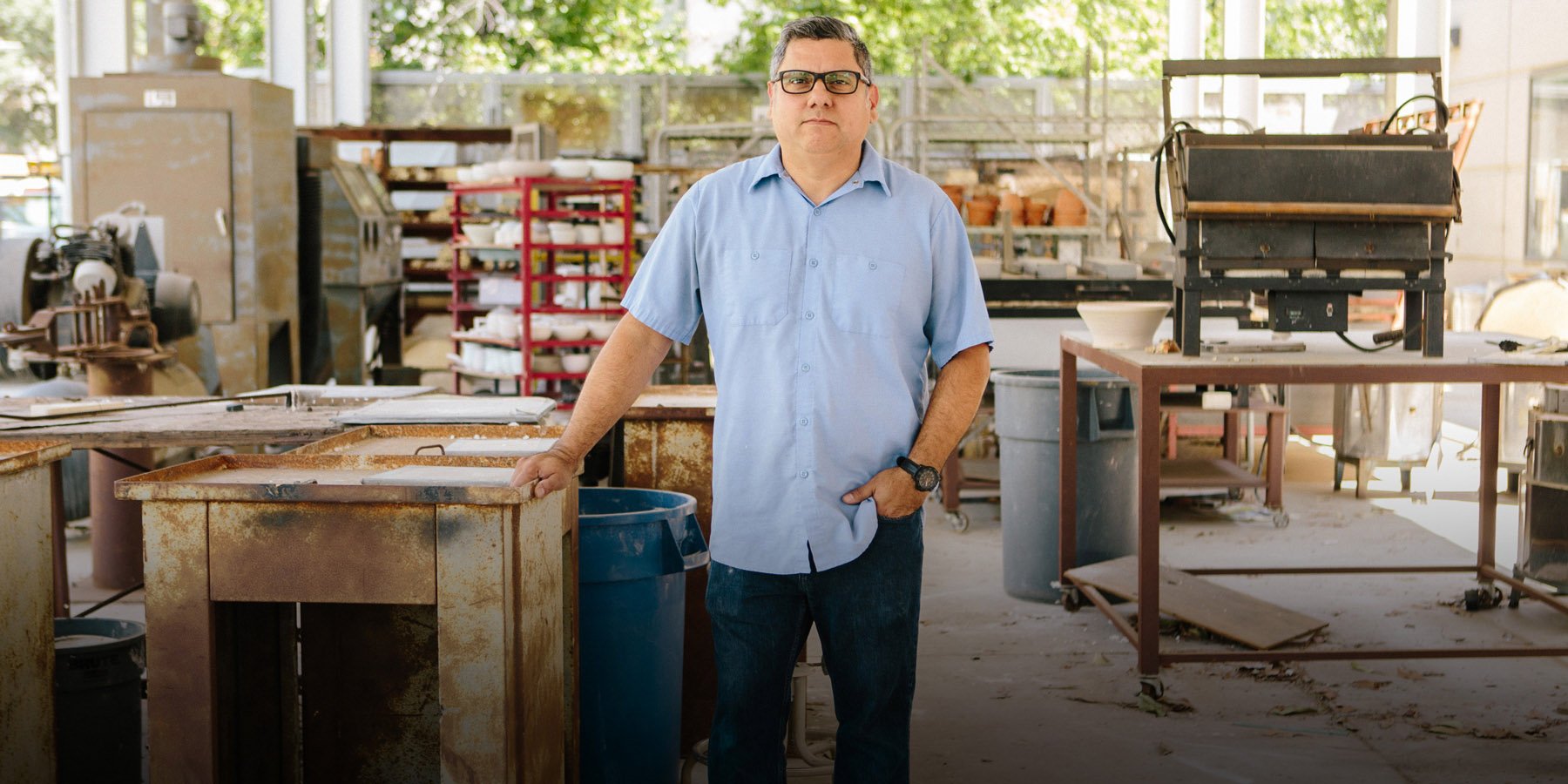
Ed Gomez in his studio where he teaches sculpture at California State University, San Bernardino.
Ed Gomez is an interdisciplinary artist, educator, curator, and Professor of Art and Design at California State University, San Bernardino. Working across abstract and representational painting, printmaking, graphic design, video, sculpture, and conceptual approaches, Gomez examines exhibition practices, institutional frameworks, and the systems that shape how art circulates, gains meaning, and enters public life.
His work has been exhibited nationally and internationally, including in Berlin, Istanbul, Rome, and Ciudad Juárez. But alongside his individual studio practice, Gomez has also devoted much of his career to a larger question: What can artists create when existing institutions do not make room for the work, communities, or conversations that matter to them?
In 2006, Ed co-founded the MexiCali Biennial with artist and collaborator Luis Hernández. What began as an artist-led intervention across the California–Mexico borderlands grew into a long-running binational platform for contemporary art, cultural exchange, publishing, research, archival work, and collaboration.
From DIY to “do it together”
One of the most resonant parts of this conversation is the MexiCali Biennial’s origin story.
The project was not born from abundant funding, institutional endorsement, or a preexisting infrastructure. It began with a handful of artists, limited resources, an alternative art space in Mexicali, and an understanding that creating a context can itself be an artistic act.
Ed describes how the Biennial adopted the language, visual identity, and institutional weight of the biennial format in order to make a small artist-run project visible and legible in the broader contemporary-art world. It was a strategic gesture: creating something people could see and believe in, even before it had the resources typically associated with a major art institution.
Over nearly 20 years, that gesture has developed into exhibitions, cross-border activations, scholarship, publications, archives, and community relationships. The story is a reminder for artists, organizers, writers, and cultural workers: the lack of an invitation does not have to be the end of the story.
As Luis Hernández has put it, this work is not only DIY. It is DIT: do it together.
What are paranormal borders?
Paranormal Borders is the sixth major iteration of the MexiCali Biennial. The project explores the border as more than a physical dividing line between the United States and Mexico. It approaches the border as a portal, a historical palimpsest, a site of fear and imagination, and a force that increasingly reaches far beyond its geographic location.
The word “paranormal” opens multiple meanings at once:
It suggests ghosts, strange lights, UFOs, and the uncanny.
It points to histories that have not been resolved and therefore continue to haunt the present.
It names experiences that feel abnormal but have become normalized: surveillance, militarization, displacement, intimidation, and disappearance.
It asks who has the power to define another person as alien, foreign, dangerous, or outside the boundaries of belonging.
In our conversation, Ed reflects on the ways the border has expanded through enforcement, surveillance, and fear. When border policing appears in cities and communities far from the geographic boundary, people may begin to feel that the border has come to them. That is one of the central questions animating Paranormal Borders: How do we understand the border when it moves through everyday life?
Ghosts, aliens, and collective memory
The paranormal is not merely a visual aesthetic in this project. It is a way of thinking through the past, the present, and the futures that remain unresolved.
A haunting is often evidence of something that refuses to disappear. It can be a story, an injustice, a displacement, a lost possibility, an inherited fear, or a history that official narratives have tried to silence. In this sense, ghosts become a framework for thinking about the long afterlives of colonization, racialization, migration policy, capitalism, and border-making.
The episode also explores the language of “alienness”—including how the word has been used politically to frame undocumented people as external threats, even as science fiction and public conversations about UFOs and unidentified aerial phenomena have made the idea of the alien culturally familiar. The question is not only whether there is life elsewhere in the universe. It is also who gets treated as fully human here.
This is where art becomes vital. Art can hold ambiguity. It can make a space for play, speculation, grief, critique, desire, and collective reflection at the same time. It can name the conditions we are living through while also making room to imagine a different outcome.
Art as agency
At the heart of this episode is a message that speaks directly to the ethos of Your Art Is a Spell: artists have agency.
That does not mean that structural barriers are imaginary or that collective problems can be solved through individual positivity. It means that imagination is not passive. It is one of the places where new language, new relationships, new institutions, and new futures can begin.
Ed’s practice offers a powerful example of that principle. His work moves between media and methods—painting, sculpture, design, video, conceptualism, teaching, curating, and organizing—because the question determines the form. And when the existing art world did not offer sufficient opportunities or frameworks, he and his collaborators made their own.
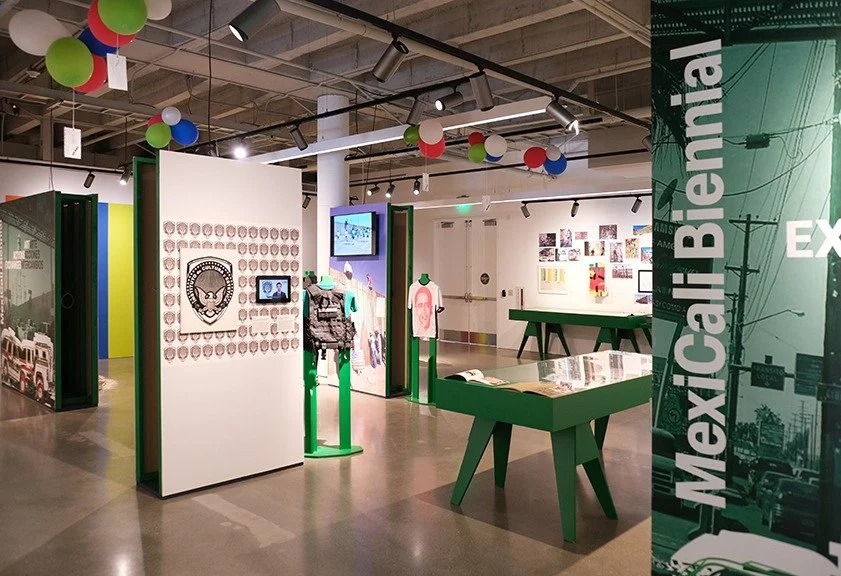
MexiCali Biennial Archive installed at The Cheech Marin Center For Chicano Art in Riverside, California.
The MexiCali Biennial shows what can happen when artists work across disciplines, places, institutions, languages, and communities—not to erase difference, but to create meaningful exchange across it.
Watch or listen to the episode
In this episode, Ed Gomez and I discuss:
The origin and evolution of the MexiCali Biennial
How artist-run projects can create their own legitimacy and momentum
The border as a physical site, political technology, portal, and haunting
Paranormal Borders and its engagement with ghosts, UAPs, alienness, memory, and displacement
Why the past is never as far away as we are taught to believe
The power of building with others: DIY becomes DIT, or “do it together”
How artists can make the exhibitions, archives, platforms, and worlds they need
Watch the full episode on YouTube:
Listen to Your Art Is a Spell:
The upcoming Paranormal Borders exhibitions are expected to include 67 artists across venues in Imperial Valley, Calexico, and Mexicali, beginning in October, with a presentation at The Cheech in Riverside scheduled to open March 13, 2027.
Stay connected
To follow the MexiCali Biennial, upcoming Paranormal Borders programming, and the organization’s archival and publishing work, visit the MexiCali Biennial website and follow them on Instagram.
For more conversations about contemporary art, creative practice, spiritual inquiry, cultural memory, and the power of making meaning, subscribe to Your Art Is a Spell on YouTube and your favorite podcast platform.